Every week, a business in Kerala comes to us with the same story.
They had an app idea. They hired someone cheap to build it — a freelancer, a small local shop, maybe an agency that quoted the lowest number. Six months and several lakhs later, the app exists. It launches. And then nothing works the way it should. It crashes on certain phones. It’s slow. Adding a new feature takes weeks and breaks two others. Users leave. The business is stuck.
The idea wasn’t the problem. It rarely is. The problem was treating mobile app development as a commodity — something to be purchased at the lowest price rather than built with the right architecture, the right process, and the right people.
This is the conversation nobody in the mobile app industry wants to have openly. So let’s have it.
The “Built It, Now What?” Problem
There is a widespread misconception that the hard part of a mobile app is building it. Get the app live, the thinking goes, and the rest will follow. Downloads, users, revenue — it’ll come.
The reality is the opposite. Building the app is the beginning of the cost, not the end of it.
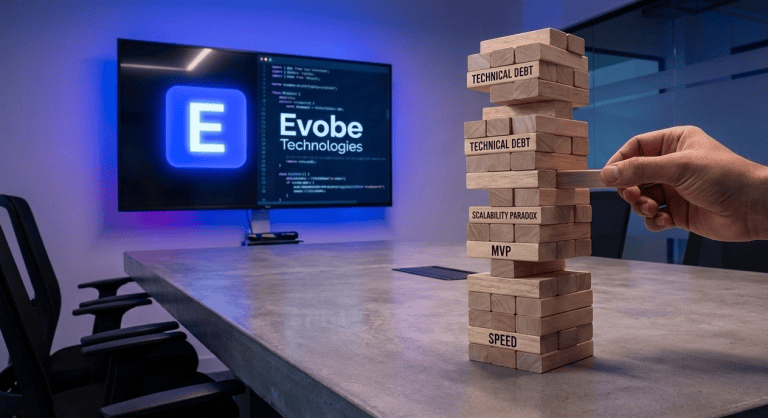
An app that is poorly architected from the start becomes progressively more expensive to maintain and improve over time. Every new feature takes longer because the codebase is tangled. Every update carries the risk of breaking something else. Every time your user base grows, performance degrades because the foundation wasn’t built to scale.
We call this the “Built It, Now What?” problem. The app exists, but it’s a liability, not an asset. And the cost of fixing a poorly built app — refactoring the architecture, rebuilding the backend, migrating data — almost always exceeds the cost of building it correctly from day one.
At Evobe, we’ve inherited enough broken apps to know exactly what goes wrong and why. Here’s the short version.
What Actually Goes Wrong in Most Mobile App Projects
The backend is an afterthought.
Most app developers think in screens. They build what the user sees — the UI — and bolt on a backend to support it. This produces apps that look fine in a demo but fall apart under real conditions. A proper mobile app starts with the backend architecture: how data is structured, how the API is designed, how the system behaves under load. UI is the last thing to build, not the first.
Cross-platform is done wrong.
Flutter and React Native have made it genuinely possible to build one codebase that runs well on both iOS and Android. But “possible” is not the same as “automatic.” Done correctly, cross-platform development delivers a fast, native-feeling experience at significantly lower cost than maintaining two separate codebases. Done poorly — as it often is, by developers who treat cross-platform frameworks as shortcuts rather than disciplines — it produces an app that feels slow, generic, and slightly off on every platform it runs on.
Security is ignored until it becomes a crisis.
Authentication vulnerabilities, unencrypted data storage, exposed API endpoints — these are not edge cases in mobile development. They are common failures that happen when security is treated as a final checklist item rather than a foundational design principle. An app that handles user data — which is essentially every app — must be built with security as a first-class concern from line one of code.
There’s no plan for what comes after launch.
App Store Optimisation. Push notification strategy. Crash monitoring. Performance analytics. User feedback loops. The infrastructure for growing and maintaining an app post-launch is as important as the app itself. Most developers hand over a build and disappear. A genuine mobile app development company in Kerala stays involved — because launch is the beginning of the journey, not the end.
What Good Mobile App Development Actually Looks Like
Here’s how Evobe approaches a mobile app project — and what every serious app development engagement should look like, regardless of who you work with.
Discovery before design.
Before a single screen is designed, we need to understand your users deeply. Who are they? What problem are they trying to solve? Where do they get frustrated in the current experience? What does success look like for them — and for you? This discovery phase is not a formality. It directly determines every technical and design decision that follows.
Architecture first.
We spend real time on system architecture before writing application code. Database schema, API design, authentication model, third-party integrations, offline behaviour, data sync strategy — all of this is mapped out and reviewed before the build begins. This is the single most important thing that separates apps that scale from apps that break.
Design for the platform, not just the screen.
iOS and Android users have different expectations, different navigation patterns, different interaction conventions. An app that ignores this — that simply replicates a website layout on a phone screen — feels wrong to users even if they can’t articulate why. We design for the specific platform conventions of each operating system, whether we’re building natively or cross-platform.
Ship in iterations, not in one big bang.
The most dangerous mobile app project is one that spends eight months building in secret and launches with a complete product on day one. We believe in shipping an MVP — a focused, well-built version of your core value proposition — getting it in front of real users, learning from their behaviour, and iterating. This is faster, cheaper, and dramatically reduces the risk of building something users don’t actually want.
Measure everything.
Every app we build goes out with analytics, crash reporting, and performance monitoring integrated from day one. We want to know which features users engage with, where they drop off, what’s causing errors, and how the app performs across device types and network conditions. Data is how you make decisions about what to build next.
The Platforms We Build On
React Native
Our primary cross-platform framework. React Native enables us to build iOS and Android apps from a single codebase without sacrificing performance or the native feel that users expect. It also dramatically reduces time-to-market and ongoing maintenance costs — a significant advantage for startups and growing businesses that need to move quickly.
Flutter
For projects that require particularly complex UI or very high visual fidelity, Flutter delivers exceptional results. Backed by Google and increasingly mature in the ecosystem, Flutter is our choice when the visual experience is a core part of the product’s value proposition.
Native iOS (Swift) and Android (Kotlin)
For applications with highly specific performance requirements, deep platform integrations, or enterprise-grade security needs, native development remains the right call. We build native apps when the use case genuinely demands it — not as a default that inflates project cost and timeline.
Backend & APIs
A mobile app is only as good as the backend powering it. We build robust, scalable backend systems — primarily on Node.js and Python — with well-structured REST or GraphQL APIs, cloud-native infrastructure on AWS or GCP, and the security and monitoring frameworks your production app needs.
Industries We Build Apps For in Kerala and Beyond
The businesses that benefit most from custom mobile app development are those where a well-designed app changes the fundamental experience of interacting with the product or service. We’ve built for:
Retail & E-commerce — Shopping apps, inventory management tools, and loyalty platforms that keep customers coming back and operations running smoothly.
Healthcare — Patient-facing appointment and consultation apps, clinical workflow tools, and health monitoring applications built to the security and compliance standards healthcare data demands.
Logistics & Field Operations — Driver tracking, delivery management, and field service apps that give operations teams real-time visibility and give customers confidence.
FinTech — Payment tools, wallet applications, and financial dashboards built with the security architecture that financial data requires from the ground up.
EdTech — Learning platforms, course delivery apps, and assessment tools that make education accessible and engaging on mobile.
Hospitality & F&B — Ordering, booking, and loyalty apps for restaurants, hotels, and hospitality brands that want to own the customer relationship rather than rent it through aggregators.
Why Businesses in Kerala Choose Evobe for Mobile App Development
We are not a freelance shop that takes any project and figures it out as it goes. We are not an outsourcing vendor that hands your project to whoever is available that week.
Evobe is a product engineering company. We’ve built our own internal products. We understand what it takes to build software that survives contact with real users — the edge cases, the unexpected behaviours, the performance cliffs, the security vulnerabilities that only emerge at scale.
When you work with us as your mobile app development company in Kerala, you get a team that has lived on the other side of the decisions we make. We build apps the way we’d want our own built — with architectural integrity, genuine user empathy, and the long-term maintainability that makes them assets rather than obligations.
We work with startups that have an idea and a deadline, SMEs that need to digitise an operational workflow, and enterprises that need a consumer-facing app that represents their brand at the highest level. Every engagement is scoped honestly, delivered transparently, and supported after launch.
If you want to work with a company that will tell you the truth about what your project needs, build it with the engineering discipline it deserves, and stay invested in its success after launch — let’s talk.

Krishnendu B Nair
Software Developer and Tech Enthusiast. Writing about code, automation, and the future of SaaS.